Your Favorite Hunting and Gathering Land Now Pays for a Foreign Pension Fund
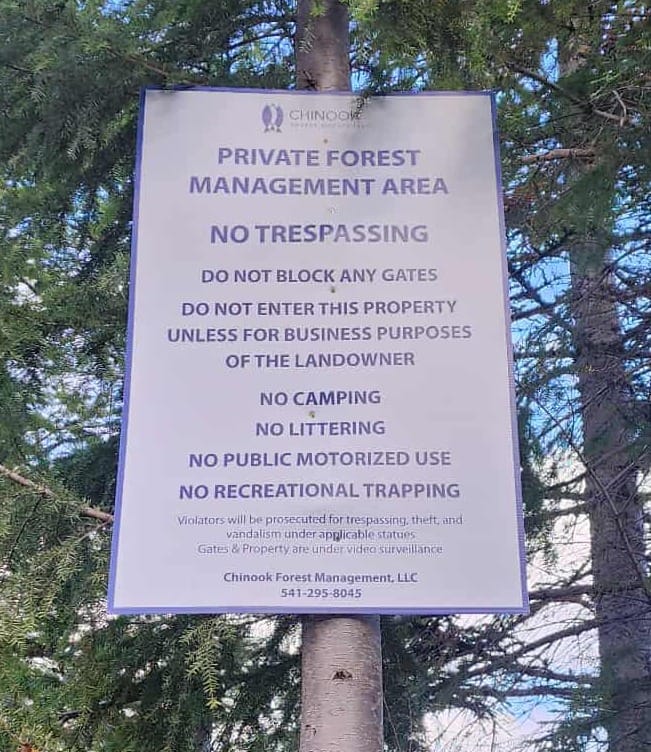
Have you noticed it yet? Try to go out scouting for this upcoming State hunting season? What about Tribal? Just want to go on a cruise on logging roads? Well, it won’t be too long before you do notice it. My brother recently snapped a photo of a gated off road that he has hunted on for years. He immediately called me and asked about the One Big Beautiful Bill or the Roadless Rule being rescinded to see if WA Land was up for sale already.
Recorded on June 20, 2024, the $25.6-million sale transferred dozens of parcels that were previously managed by Weyerhauser to a Delware-registered holding company called Green Canyon Timberlands LLC. The deal looks like a normal land-transfer for logging, but upon deeper inspection it reveals that Green Canyon is a shell entity for a new foreign-backed investment platform financed by CDPQ (Caisse de dépôt et placement du Québec, “Quebec Deposit and Investment Fund”), one of the world’s largest pension funds.
From Traditional Logging to Financial Portfolios
Weyerhauser, the century-old Seattle timber giant, has been divesting selective tracts in western Washington as it refocuses operations. Green Canyon Timberlands, the buyer, was incorporated in Delaware in June 2024 and registered in Washington shortly before the sale. Its manager, Quinnat Resources GP LLC, is another Delaware entity controlled by Chinook Forest Partners, an Oregon-based investment manager that specializes in “Natural Capital.”
In a September 23, 2024 press release, CDPQ announced it had acquired a minority ownership stake in Chinook Forest Partners and was launching a new U.S. forestland platform to “build a diversified and high-quality portfolio of forestland in the Pacific Northwest” (https://www.lacaisse.com/en/news/pressreleases/cdpq-launches-platform-focused-us-forestland-invests-chinook-forest-partners?utm_source=chatgpt.com).
CDPQ, which manages over CAD $450 billion (~$330 Billion USD) in assets for Quebec’s public pensioners, described the initiative as part of its Sustainable Land Management program. The fund has framed its forestry investments as both a hedge against inflation and a contribution to climate-aligned investing, converting forests from raw-natural resources into long-term “natural capital” assets that produce revenue from timber, carbon credits, and land appreciate.
What are the facts?
The official record, King County Instrument No. 20240620001348, lists Weyerhauser as Grantor and Green Canyon Timberlands, LLC as Grantee, represented by one Kelly Droege, a managing partner at Chinook.
The deed’s Exhibit A identifies 45 parcels that span Townships 19-21 North, Ranges 10-11 East, and stretches from the Naches Trail corridor near Greenwater south, toward the Pierce County line. Together, the tracts cover an estimated 24,000 acres of mixed forest connecting with Mt. Baker-Snoqualmie National Forest lands.
It’s Exhibit B – Permitted Encumbrances outlines the rules that “run with the land”:
1. The property is legally limited to forest and timber use under current zoning regulations by King County.
2. It is subject to riparian rights on the White River and other waterways, affirming that the shorelines of navigable waters remain public (so, one might think you could assert your treaty-right to fish here).
3. All public-road easements remain intact, but private timber roads may be gated or closed (so, say goodbye to your favorite spur road as my brother has discovered).
4. Environmental and conservation restrictions may further limit non-forestry development.
In short, this recorded document explicitly allows the owner to restrict access on private roads and lands not covered by public easements.
Implications for the Public and the Land
For local residents, recreationists, and Tribal/State hunters who have relied on informal access or permit access across Weyerhauser’s road network, this marks a shift to a financial-investment model that could mark the end of open gates. Under Washington Law (RCW 77.15.435), entering private timberland without permission does indeed constitute a trespass, and, well, nothing in this deed grants the public access beyond what already existed.
So, why are they doing this?
Basically, CDPQ and Chinook want to pursue carbon offset projects on this land. It could potentially limit logging, as it seems their stance is “sustainability,” but it also monetizes the forest’s carbon storage capacity.
Tribal Considerations
The tracts lie directly within traditional territories used by our people (Muckleshoot) and other Tribal peoples as well. In the deed, I have not come across any reference to Tribal consultation. CDPQ’s own materials state that its investments align with the United Nations Declaration on the Rights of Indigenous Peoples, but who knows if they will uphold such commitments when it is localized directly.
This “Natural Capital” trend is part of a broader one. CDPQ’s entry into Washington mirrors other investment firms buying timber, farmland, and water rights worldwide under the banner of sustainability. For example, in 2021, Campbell Global sold 100,000 acres of Oregon and Washington timberland to JPMorgan Asset Management for Institutional Investors (https://am.jpmorgan.com/us/en/asset-management/adv/about-us/media/press-releases/jp-morgans-campbell-global-acquires-over-40-000-acres-of-timberland-in-the-us-pacific-northwest/).
I am not an expert, in any capacity, but it seems to me that investors are attracted to a natural-capital platform of investing. I guess even when we’re in a recession, timberlands still produce and even appreciate, and carbon markets promise a new revenue stream and are reputationally-good.
Public Roads and Easements
Several U.S. Forest Service Roads (NF-70, NF-72, NF-73) traverse or border these sections under right-of-way agreements that date back to the 1950s. If those easements are federal, the company cannot block them without express approval from the U.S. Forest Service. Nevertheless, most spur roads branching from them are private, and they can, and will, put up gates at those junctions. Recreationalists will st ill be able to drive FS roads, but side roads into the timberlands will require permission or a paid permit if they so-choose to adopt a Weyerhauser-style program.
Muckleshoot’s Potential Outlook
With control of 24,000 acres of forestland near Greenwater and our own Muckleshoot Federal Corp land, we face a moment where asserting our roles as stewards of our ancestral lands is of the utmost importance. These lands are our ancestral territory, and many of us grew up hunting or harvesting in them, I mean, portions of these parcels are on Huckleberry Mountain, and border Twin Camps.
1. Consultation Protocols
The Tribe should seek to establish clear consultation procedures for any forestry or land management activities that could affect:
· Salmon-bearing streams,
· Cultural sites or traditional-use areas, and
· Archaeological or burial locations within our ancestral landscape.
Formalizing this process would ensure that our Wildlife, Culture, and Preservation are notified and engaged before ground-disturbing or high-impact operations begin, or any operations that may otherwise negatively impact wildlife, and thus, our treaty-right to hunt.
2. Treaty-Based Access Rights
On the part of treaty-rights, the Tribe should also pursue MOUs guaranteeing ceremonial access for hunting, fishing, and gathering, consistent with our treaty rights.
These agreements could reaffirm our rights to practice cultural traditions on the very lands where our ancestors did, while building trust and mutual respect with the new landowners.
3. Co-Management Opportunities
There is tremendous potential for co-management partnerships in:
· Habitat restoration and riparian buffer protection,
· Road decommissioning and watershed health projects, and
· Wildfire mitigation planning, especially given the steep terrain and proximity to residential areas and public lands. But, of course that entirely depends on our own ability to manage wildfires.
The Tribe already partners successfully with Manulife Investment Management on sustainable forestry and conservation initiatives. Building a similar framework with Chinook Forest Partners and their financier CDPQ could become a model of Indigenous and corporate collaboration based in respect, science, and sovereignty. And, well, the financier of these shell companies are incredibly powerful.
By acting early, while CDPQ’s Pacific Northwest forestry platform is still taking shape, Muckleshoot has the chance to set the tone for how global investors engage with tribal nations. Rather than being excluded from decisions about our traditional lands, we can take the lead in shaping how these forests are managed for future generations.
Fun-Fact: Have you noticed these shell companies are all based in Delware?
Most landholding companies register in Delaware because it offers privacy, so the “real” owners can hide who controls the company. The courts are incredibly business-friendly – Delaware’s Court of Chancery specializes in corporate law, which favors investors. It also has no State Tax on income earned outside of Delaware, so it’s a flexible structure for partnerships and funds, and, well, it’s super-fast and inexpensive to form LLCs and you can create layers of ownership for protection or anonymity. In sum, Delaware lets corporations and investors own property anywhere in the U.S. without revealing their identity, which is why global financiers use Delaware LLCs to hold Washington timberlands through entities such as Green Canyon Timberlands and Quinnant Resources GP LLC. Actually, looking at the Grantor/Grantee in the deed, and the sale history, even Weyerhauser has transferred their registration to Delware.
Parcel IDs Purchased (Instrument # 20240620001348) :
PID: 0119119001 SEC: 1 TWP: 19 RGE: 11
PID: 0120109005 SEC: 1 TWP: 20 RGE: 10
PID: 0319109001 SEC: 3 TWP: 19 RGE: 10
PID: 0319119001 SEC: 3 TWP: 19 RGE: 11
PID: 0320119001 SEC: 3 TWP: 20 RGE: 11
PID: 0220109001 QTR: NE SEC: 2 TWP: 20 RGE: 10
PID: 0519109001 SEC: 5 TWP: 19 RGE: 10
PID: 0519119001 SEC: 5 TWP: 19 RGE: 11
PID: 0520119001 SEC: 5 TWP: 20 RGE: 11
PID: 0620119001 QTR: NE SEC: 6 TWP: 20 RGE: 11
PID: 0719119001 SEC: 7 TWP: 19 RGE: 11
PID: 0720109001 SEC: 7 TWP: 20 RGE: 10
PID: 0720119001 QTR: NE SEC: 7 TWP: 20 RGE: 11
PID: 0919119001 SEC: 9 TWP: 19 RGE: 11
PID: 0919109001 SEC: 9 TWP: 19 RGE: 10
PID: 0920109001 SEC: 9 TWP: 20 RGE: 10
PID: 0920119001 SEC: 9 TWP: 20 RGE: 11
PID: 1119109001 SEC: 11 TWP: 19 RGE: 10
PID: 1119119001 SEC: 11 TWP: 19 RGE: 11
PID: 1120109001 SEC: 11 TWP: 20 RGE: 10
PID: 1320109001 SEC: 13 TWP: 20 RGE: 10
PID: 1420109001 QTR: NE SEC: 14 TWP: 20 RGE: 10
PID: 1519119001 SEC: 15 TWP: 19 RGE: 11
PID: 1520109001 SEC: 15 TWP: 20 RGE: 10
PID: 1520119001 SEC: 15 TWP: 20 RGE: 11
PID: 1620109001 QTR: NE SEC: 16 TWP: 20 RGE: 10
PID: 1720109001 SEC: 17 TWP: 20 RGE: 10
PID: 1719119001 SEC: 17 TWP: 19 RGE: 11
PID: 1720119001 QTR: NE SEC: 17 TWP: 20 RGE: 11
PID: 1921119001 QTR: NE SEC: 19 TWP: 21 RGE: 11
PID: 2119119001 QTR: NE SEC: 21 TWP: 19 RGE: 11
PID: 2120119001 SEC: 21 TWP: 20 RGE: 11
PID: 2120119005 QTR: NW SEC: 21 TWP: 20 RGE: 11
PID: 2320119001 SEC: 23 TWP: 20 RGE: 11
PID: 2520119001 SEC: 25 TWP: 20 RGE: 11
PID: 2720119001 SEC: 27 TWP: 20 RGE: 11
PID: 2920119001 SEC: 29 TWP: 20 RGE: 11
PID: 2921119001 SEC: 29 TWP: 21 RGE: 11
PID: 3121119001 SEC: 31 TWP: 21 RGE: 11
PID: 3220119001 QTR: NE SEC: 32 TWP: 20 RGE: 11
PID: 3320109001 SEC: 33 TWP: 20 RGE: 10
PID: 3320119001 SEC: 33 TWP: 20 RGE: 11
PID: 3321119001 SEC: 33 TWP: 21 RGE: 11
PID: 3520119001 SEC: 35 TWP: 20 RGE: 11
PID: 0119109001 SEC: 1 TWP: 19 RGE: 10