A Model of Decolonial Leadership as a Relational Ontology
Leadership is a tricky subject. It is often treated as if its meaning is blatantly obvious – but, in reality, it is highly subjective and shaped by ones own experiences, their values and assumptions (biases) about power. In many contexts however, leadership is imagined as something naturally located at the top: the person in charge, the one with the title, the one who directs others from above, as if a symphony conductor telling the orchestra when to hit the high or low notes, right on cue. But, in a Tribal context, it is my perspective that leadership should not be so narrowly understood. In fact, I think leadership is one of the most important areas in which we must think critically, because how we define leaderships says a great deal about how we understand governance, responsibility and our relationship with one another as Tribal kin.
I often think about the well-know phrase, “Ask not what your country can do for you, but what you can do for your country.” While that statement is often presented as a noble call to service, I think it also raises a bigger question: what is leadership actually for? Is leadership about mobilizing people into service of the state, or institution? Is it about obedience to a larger machine, or system? Or should leadership be based in serving the will, wellbeing, and needs of the people? In a tribal context especially, I do not think we should accept the assumption that leadership is simply top-down authority. I believe leadership, if it is to be meaningful for us, must be understood as inherently decolonial.
Traditionally, our leaders were not simply those who occupied a superior rank over others. They were recognized by others through their generosity, work, and their own self-inscribed responsibility to others. A leader gathered, hunted, provided, fished, and then gave away what they had through potlatch and other forms of redistribution. Leadership was demonstrated through graciousness, self-sacrifice, and the willingness to care for the people. In that sense, leadership was not built on the accumulation, but on giving. What gave a leader standing was not the wealth they kept for themselves, but one where wealth was circulated outward in ways that strengthened the community. The concept of “prestige” came through their reciprocity, not their hoarding – it was relational.
This stands in a very sharp contrast to many modern forms of governance, especially today in our own governance. Today, leadership is often associated with title, office, salary, and the bureaucratic (and one might say even more insufficient than our Federal government) rank emblematic of the Federal government. IN many Tribal contexts, this has been shaped in party by governance structures formalized through the Indian Reorganization Act of 1934 and the subsequent IRA constitutions. While these constitutions were later adapted and interpreted by Tribes, they were nonetheless grounded in a model of governance that reflected the settler assumptions about hierarchy, representation, administration, and centralized authority. RE: Tribal “Chiefs” appointed by the Federal Government (not traditional “Chiefs” or “Headman” or “Tyees”) for purposes of the treaty-making process. Too often, these structures operate like what Gareth Morgan, in his book "Images of Organizations" would call a Machine. In his Machine metaphor, Morgan illustrates an organization that is treated as a series of parts arranged into a fixed hierarchy, with the authority flowing from the top downward. Each person, then, becomes a component, or “cog”, in a much larger apparatus, valued only for carrying out a specific role within the system, and any cog that strayed from that role, was “fixed.” Leadership in this model becomes a matter of control, supervision, and “efficient” management.
That machine-like model is precisely where I begin to disagree. Though, I understand this model is effective for any sort of economic enterprise a Tribe may have. However, I digress – Tribal leadership should not be imaged as a flowchart with one person(s) at the top and everyone else branching below. That image is not a neutral one. It carries a whole philosophy of organization with it. It assumes that governance works best through a rank, compartmentalization, and command structure. It assumes that legitimacy comes from office. But in a Tribal context, that is not the only possible way to understand leadership, and I would argue it is often the wrong one.
Morgan’s image of organizations as political systems is also useful here. Organizations are never just a neutural administrative structure. They are inherently sites of power, negotiation, competition, and struggle for legitimacy. I think that his is particularly important because it helps explain why the problem is not simply whether current leaders are good or bad people. The issue is deeper than that. It is that certain organizational forms privelages certain types of power. When leadership is organized through imposed or inherited colonial structures, those structures can centralize that authority, weaken the reciprocal accountability (or relational accountability as Wilson [2008] defines it) , and distance themselves from the people. In such a system, office itself can begin to stand in for said legitimacy, even when the actual relationship between leadership and community has become a source of strain.
This is where I find the idea of decolonial leadership so important in my role within the Tribe. Decolonial leadership is not simply about making existing leadership more inclusive, nor is it just about placing Indigenous people into already existing positions of authority. Nor do I also think it is inherently about getting rid of the IRA system we have inherited. Rather, it is about asking who gets to decide what leadership looks like, what kind of power is normalized, and what forms of accountability are ignored. Drawing from decolonial leadership theory, leadership should not be understood primarily as an individual trait possessed by some heroic figure at the top. Instead, it should be understood as a collective process through which communities reclaim their meaning, their identity and authority from the colonial systems that have long sought to define reality for them.
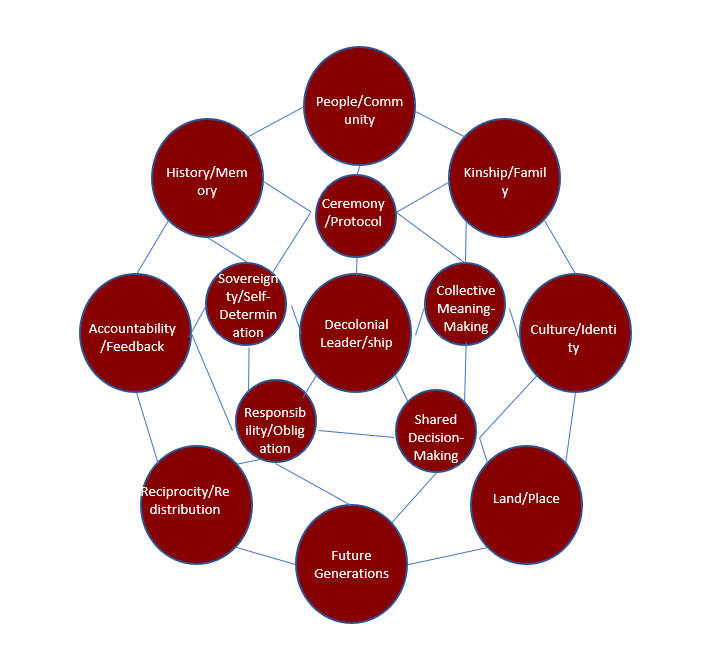
This matters because colonialism did not only take land. It imposed ways of organizing life, governance, identity (by virtue of Western administrative processes), and legitimacy (as defined by the state). It taught people to see the hierarchy as natural, bureaucracy as rational, and professional distance as authority. But, as we have seen in many previous leaders (CEO, COO, CFO, CIO) in our Tribe, when one distances themselves from the community, and does not integrate themselves into our community, they are often incompatible in our community as leaders and subsequently forced to resign or terminated from their position. But these assumptions, however, are not universal truths. They are products of a particular historic order. Decolonial leadership challenges said order by making space for other ways of knowing, other ways of governing, and other ways of relating. It challenges the idea that the leader must stand above the people. Instead, it places the leader within a web of obligations, responsibility, and accountability – as redundant as that is, I stress the import of such notions. This is ontology as I frame it - it is a web of nodes all interconnected, depicted in the cover photo of this article.
This is why I do not imagine leadership as a tree. I imagine it more like a series of connected circles, with the leader somewhere in the middle, not above everyone else, but among them. The leader is in relationship with their families, departments, community members, and yes all of the elders, youth, and even the land they reside on, and the culture they partake in, and the religion they are part of, with all of the collective responsibilities therein. In this model, leadership is not about sitting at the highest point of the structure. It is about holding relationships together. It is about listening, redistributing, responding, and remaining accountable. The center is not a throne. It is a point of pressure that holds obligation and balance.
Back to organizational theory, Morgan’s culture metaphor helps explore this point. Organizations are not just structures; they are systems of values, with their own rituals, meanings, and yes, even shared assumptions about the nature of reality. In a colonial leadership culture, leadership may be associated with status, and elements of “exclusivity”, compensation, technical “expertise”, and even distance from “ordinary” people. In a decolonial leadership culture, leadership would instead be associated with their generosity, their accessibility, the reciprocity they embody and visibility and responsibility to the community. This is why traditional models of giving matter soooo much in our communities. They aren’t just an artifact or “tradition” from the past – they offer entirely different theories of legitimacy. They show us, and remind us, that leadership was once grounded in what one gave, not what one merely controlled.
The brain, or cybernetic, metaphor also offers an important insight. If organizations are truly healthy, they must be able to receive feedback (yes, even constructive or negative feedback), and learn, self-correct, or respond to change; namely, leaders must be able to adapt and overcome adversity. A truly accountable Tribal leadership model would not just rely on a top-down directive or order. It would create a feedback loop, stemming from the people. It would ask whether leadership can hear the community, whether the community can influence decisions (hello? General council? Where are you??), and whether the system can correct itself when it drifts away from its values. Too often these institutions perform consultation without creating real mechanisms for shared influence (where are all our committees of the people to influence departments?) In that sense, they appear to be participatory, but remain structurally closed. A decolonial leadership model would require genuine responsiveness, not symbolic inclusion by having your name on a list that does not even meet.
And to conclude Morgan’s Images of Organizations, his organic metaphor just might be the closest to how I understand leadership in a Tribal context. An organism is a living system. It survives through interdependence, adaption, and relationship with its environment. Tribal governance should not be understood as a machine that is assembled of different departments, titles, committees, or mechanical structure. It is a living body shaped by the relationships of its individual cells (Tribal members), land (Reservation, Traditional land, traditional villages, hunting/fishing U&A), memory (it’s history), law (its own Tribal codes, Federal Law, and Washington law), and collective wellbeing (it’s physical, mental, emotional health for its people). Leadership, in this sense, is not an external function imposed by managers on that body. It is a part of the life of the body itself. A leader should not be detached from the people, but be part of the people and the relationships of all of the people that sustain the people.
To me, this is what decolonial leadership means. It is rejecting the assumption that leadership is best understood as commands from above. It means recognizing that many of the organizational models we have inherited are shaped by coloniality, even when they appear normal or practical. It means reclaiming leadership as a relational, cultural, political, and collective practice forged through service, generosity accountability, and the courage to challenge the imposed structures. It also means recognizing that such leadership is not always safe. Truly decolonial leadership can be disruptive because it refuses to be merely symbolic. It asks for actual change in how decisions are made, how power is collectively distributed, and how this authenticity is understood.
In the end, I do not believe a leaders should be measured primarily by title, their income, or place in the machine. I believe a leader should be measured by the responsibilities they carry, the relationships they hold dear and honor, and the extent to which they remain answerable to the people. Colonial leadership places a leader above the people. Decolonial leadership places the leader within a field of obligations. That, to me, is the way forward.
So how do I apply this, as a manager within the Tribe?
I consider myself a decolonial manager. I try to listen, before I direct my staff; I do not assume that my title gives me all of the knowledge. I build decisions with, and from, the people whom I work with.
I treat staff as if my own cousins, not just employees.
I use my authority carefully. I still have to make decisions and set expectations, and protect processes, but I do not confuse anyone with superiority.
I give credit where credit is due. I do not hoard information or influence or visibility. I open myself up to anyone, I aim to mentor others, and I ensure that recognition is shared. I alone, am not responsible for successful projects.
Anyone can disagree with me. I do not take it personally.
I protect those around me from the bureaucracy when it is necessary. I push back on harmful policy and I do not let institutional pressure push on to those whom I "manage."
I share information, I make time, and attempt to remove barriers. I advocate for my staff and take on difficult work myself, rather than relegating it downward.
I try to keep Tribal or community-serving as the base context for the work we do every day. After all - we are serving Tribal students from our community. I aim to reconnect daily operations to our people, with our culture always on the back of my mind when I make decisions.
If I had to sum it up all in one sentence. As a manager, this model of leadership means using my position to coordinate relationships, protect people, and share power where and when possible, and keep the work always accountable to community rather than a hierarchy. Namely - I care more for what the needs of the people are asking for, rather than what those in power want.
I am not perfect. I fail. I fail often, but I learn and adapt, and do better.
-a tired dad
![qʷəd: "Track[ing]" Rather Than Extracting - Part I of My Methodology](https://storage.ghost.io/c/f3/de/f3de056e-b275-4390-b177-59d94edffad4/content/images/size/w600/2026/03/3f953d89-90ad-4977-9490-eb12b4a0003c.jpg)